01 / Your next user may arrive with an agent
Imagine a customer asking their assistant: “Find a duplicate invoice, check whether I can claim it back, and prepare the refund.” The agent finds your company, understands the documentation and locates the invoice. But it cannot identify the permission it needs, mistakes a request for a completed refund, and reports that everything is resolved. The conversation looks good. The work is still pending.
Agent Experience (AX) is the quality of the experience you provide to an agent so it can accomplish a human goal inside your product or system. It includes discovering capabilities, gaining access, interpreting information, taking action and checking what happened. The definition at agentexperience.ax places access, understanding and operation in the service of user-defined goals.
The useful business question is specific: can an agent complete the tasks our customers and employees delegate, with appropriate permissions and a verifiable result? That applies to a SaaS product, a consultancy, a shop or an internal engineering team.
| Discipline | The question it helps answer | Useful evidence |
|---|---|---|
| UX | Can a person understand, decide and remain in control? | Usability, accessibility and comprehension checks. |
| DX | Can a developer integrate and maintain the system? | Time to the first working integration. |
| GEO / AEO | Does correct information about us appear in AI answers? | Presence, attribution and accuracy. |
| AX | Can an agent use the system on the user’s behalf? | Completed tasks, respected boundaries and recovery. |
Appearing in an answer does not demonstrate that an agent can buy from you, integrate your API or resolve an incident. An easy-to-call tool does not guarantee a good human experience either: the person delegating needs to know what happened, what remains pending and how to correct it.
Agent First and AI Native: working definitions
In this guide, Agent First describes a product that considers delegated use from the start: explicit capabilities, permissions, states and machine-readable results. A thoughtful human interface remains essential. AI Native describes a product or organization whose processes incorporate AI structurally, including accessible data, evaluation, accountability and continuous learning. These terms have varying industry uses; they are not certifications.
A company can provide an excellent API for agents while operating manually inside. It can also develop software with agents while selling a product that agents cannot use. AX connects these two fronts: the product other agents use and the environment your own agents work in.
02 / Where to follow AX, and whom to read
agentexperience.ax is the strongest starting point among these references: it organizes concepts, articles and community explorations. Netlify helped establish the initiative, and the website acknowledges its involvement. Read it as an open resource hub, rather than an authority certifying a universal AX standard.
For the origin, start with Introducing AX by Mathias Biilmann, published in January 2025. To move into practice, follow Sean Roberts, who connects AX with platforms, context and measurement. For team organization, read Clifton Cunningham. His perspective complements the providers’: how a company works matters alongside the interface it exposes.
An efficient reading route: use the hub for orientation, authors for their arguments, specifications to check capabilities, and your own trials to decide where to invest. Product announcements establish that a feature is offered. Their business and performance claims need more careful scrutiny.
Four questions for any product
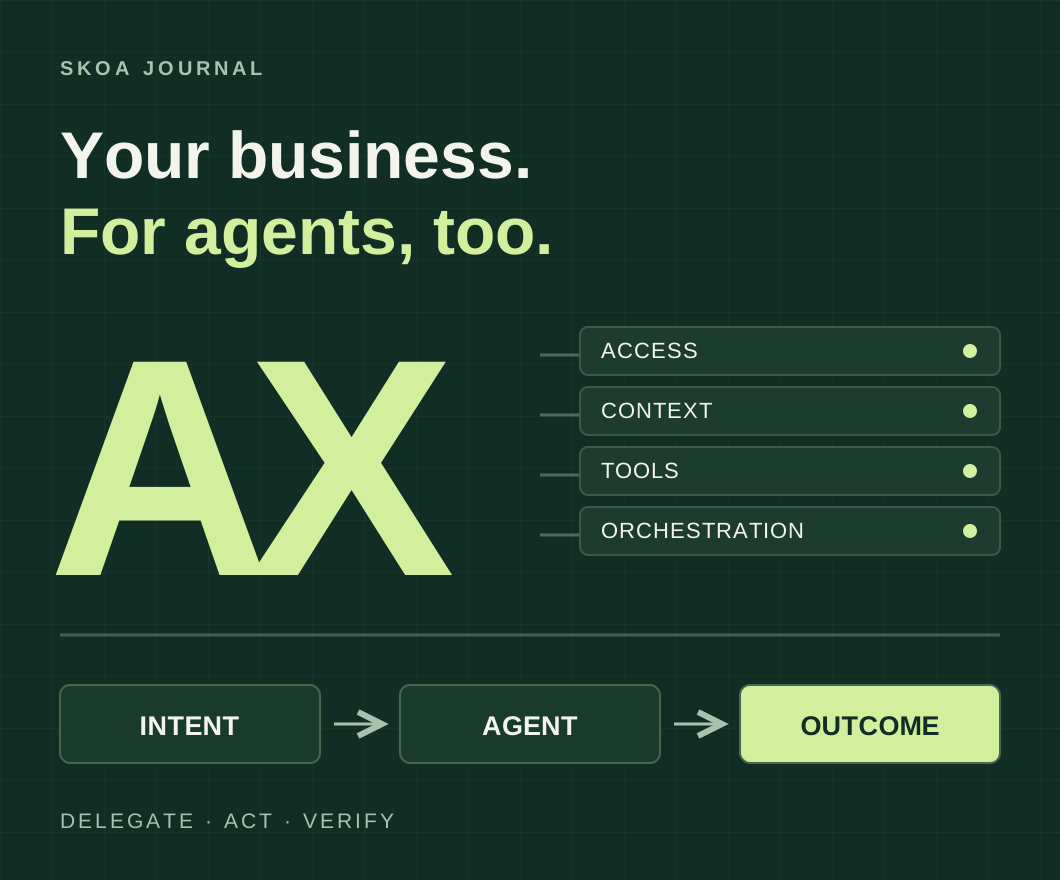
In One Year of AX (January 28, 2026), Biilmann identifies four areas: access, context, tools and orchestration. Here is our practical interpretation for an audit:
Does the agent know how to authenticate, whom it represents and when to hand control back?
Can it find current information, versions, constraints and runnable examples?
Do operations have clear inputs, explicit effects and actionable errors?
Can it continue a long task, check its state, recover or escalate?
Choose a real task and work through all four questions. “We have MCP” answers only part of the problem. “We have a chatbot” does not answer any of them on its own.
03 / What has advanced: from documents to operations
The shift from 2025 to 2026 appears in concrete components: context formats, tool protocols, delegation between agents, browser interfaces and experience evaluation. They do not form a single standard, and you do not need all of them. Status checked on November 16, 2026:
| Component | Purpose | Maturity and boundary |
|---|---|---|
| llms.txt | Provide an entry point to useful website content. | Open proposal, revised to v2 in 2026. It grants no access and guarantees no appearance in answers. |
| AGENTS.md | Give coding agents repository instructions. | Open format supported by multiple clients. Instructions are not permission controls. |
| Agent Skills | Package procedures, references and scripts around SKILL.md. | Open format, loaded on demand by compatible clients. Bundled code still needs review. |
| MCP | Connect AI applications with tools, resources and context. | Open protocol with implementations. It does not decide business rules or prove task completion. |
| A2A | Connect agent applications and delegate tasks. | The project publishes a v1.0 specification and SDKs. Test versions and capabilities at both ends. |
| WebMCP | Expose structured tools from a web page. | Proposed standard in a Chrome origin trial starting with version 149. Not universal browser support. |
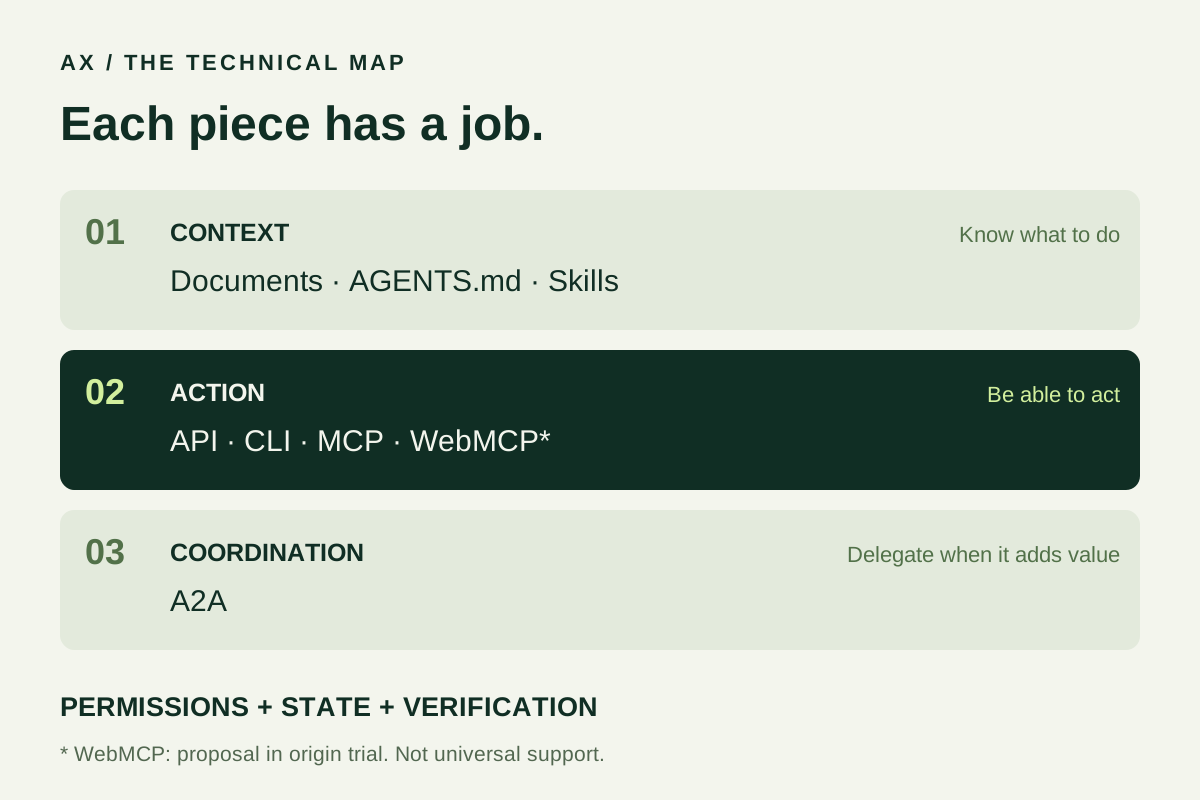
A documented API or CLI may be enough for your first use case. A skill describes how to perform work; MCP provides access to tools; A2A connects agents. WebMCP introduces a browser route, with documentation focused primarily on local workflows involving a human. These approaches can complement each other, but adding protocols does not remove the need for a well-designed operation contract.
Three practical signals from 2026
- Content that is easier to consume. Cloudflare Markdown for Agents converts HTML to Markdown on enabled zones when clients request it with
Accept: text/markdown. It reduces extraction work; it does not make content true or trustworthy. - A dedicated entry point. Netlify launched netlify.ai on April 22 to guide agents through access, context and deployment. It is a concrete example of redesigning the beginning of a journey, beyond adding documentation to an API.
- Scenario-based AX measurement. Netlify introduced AXIS on June 24: open tooling that runs scenarios and produces inspectable reports. Its score belongs to that framework and its tests; it is not an independent industry certification.
The business opportunity is to reduce friction you can already observe. If nobody can check task status, start there. If every attempt fails on permissions, longer documentation will not solve the problem.
04 / The Value Pairs lesson: design the environment
In Value Pairs, one year on (November 13, 2026), Cunningham revisits small AI-assisted teams. He emphasizes their environment: operating model, reusable assets and platform. His reflection follows discovery, delivery and validation. The article identifies itself as a draft, and its examples are the author’s observations, not a controlled productivity study.
Our interpretation for SKOA: helping someone produce code faster does not eliminate the wait to decide, test or learn. If an improvement takes an afternoon to build but requires two weeks to access data and six approvals to try, the organizational bottleneck remains.
This changes the questions behind an AI Native initiative. Alongside model selection, decide who owns the outcome, what decisions the team can make and what evidence allows it to proceed. The same group should be able to speak with a user, build a variation, check it and observe its use. Product, design, engineering and security responsibilities remain even when their distribution changes.
The 2025 DORA report offers a broader perspective: it connects AI’s value with platform and process quality, while warning about stability problems. These are observed associations, not a causal promise of savings for every business.
Give an agent a clean repository and a bounded task. Observe whether it can prepare the environment, find the right pattern, run checks and explain its changes without requesting knowledge held by one person. Each blockage reveals a dependency worth documenting, automating or simplifying.
A useful internal package can include a short project map, a reference implementation, reproducible commands, synthetic data and a way to inspect the result. That makes a concrete difference against a known baseline reviewable. Learning becomes available to the team instead of disappearing into an individual conversation.
05 / What good AX looks like in a task
Return to the duplicate invoice. This is a hypothetical design example, not a deployed case study or a SKOA API. The goal is to prepare and, where appropriate, execute a traceable refund.
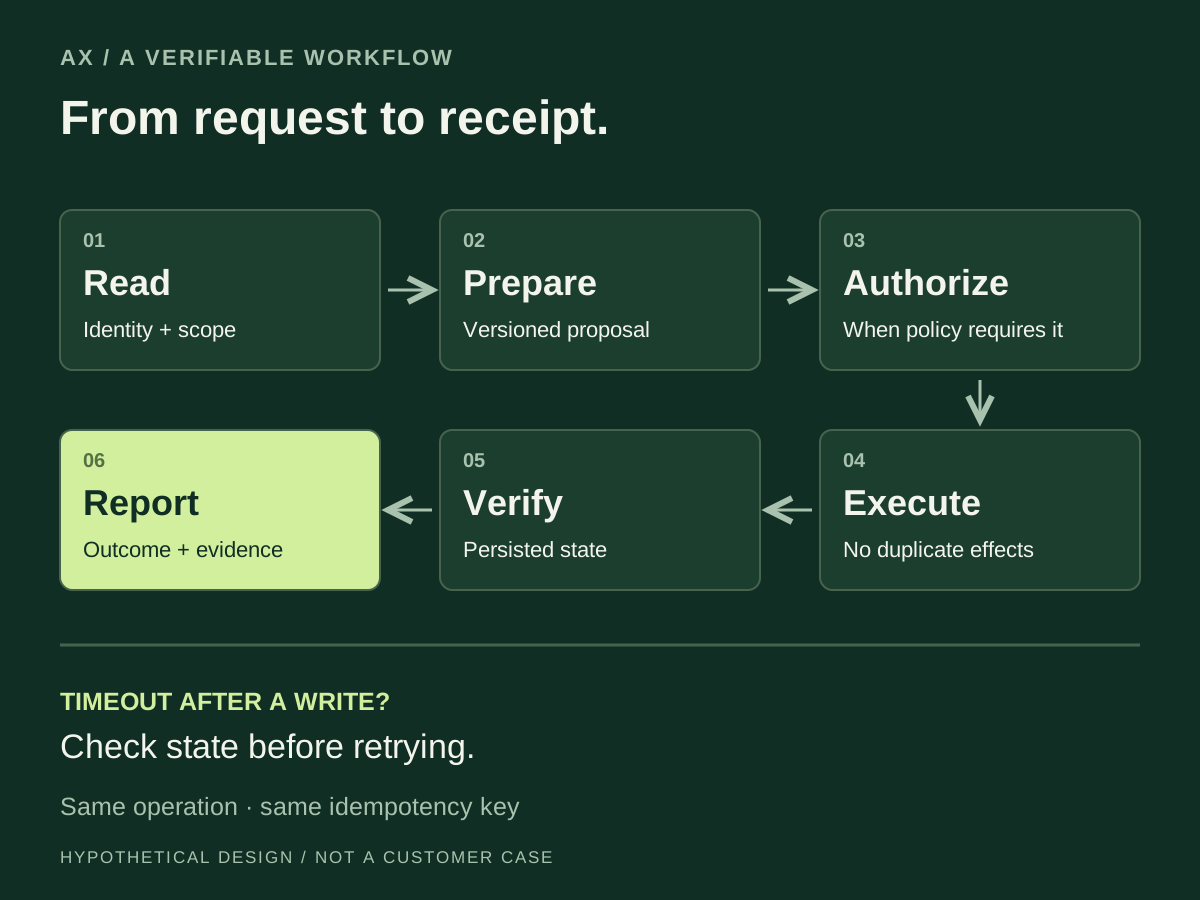
- Identify. The agent receives the organization and invoice. If there are two matches, it asks; it does not guess the account or expand its search to other customers.
- Read. With scoped read permission, it retrieves amount, currency, state and the applicable policy version.
- Prepare. A preview operation calculates the proposed outcome. It returns an identified proposal, expiry time and reasons for any rejection.
- Authorize. Where policy requires approval, the person reviews recipient, amount and effect. The server binds approval to that exact proposal; an agent’s text saying “approved” cannot replace it.
- Execute. The service revalidates permissions, policy and freshness. It uses an idempotency key: repeating the same request must not create a second refund.
- Verify and communicate. The agent checks persisted state, returns a verifiable identifier and distinguishes pending, completed and rejected. If the outcome is uncertain, it says so.
An illustrative contract could return the following. This is a design sketch; adapt the fields to the actual system:
{
  "operation_id": "refund_example_42",
  "status": "pending_approval",
  "amount_minor": 12500,
  "currency": "EUR",
  "proposal_version": 3,
  "expires_at": "2026-11-16T16:00:00Z",
  "allowed_next_actions": ["approve", "reject"],
  "trace_id": "trace_example_17"
}
Knowing that JSON does not grant approval permission. The server checks identity and granted scope. If the proposal changes, previous authorization no longer applies. If the connection drops during execution, the agent checks operation_id before trying again.
Anthropic recommends tools with clear boundaries, precise descriptions and relevant responses, evaluated with agents. In our example, “prepare refund” expresses a more verifiable intent than exposing dozens of generic operations without explaining their effects. The final interface depends on tasks and testing.
06 / Useful autonomy: boundaries enforced by the system
An agent may read an email, document or page containing malicious instructions. That content is task data, not a new authority. AX design must separate what an agent can interpret from what the service permits it to execute.
- Identity and scope. Limit credentials by user, organization, operation and time. Revocation must work outside the model.
- Executable policy. Enforce schemas, spending limits, tenant isolation and approvals in server code. A prompt can explain a rule; it cannot enforce it.
- Recoverable errors. Distinguish missing permissions, invalid data, temporary limits and transient failures. Provide an allowed next step and a support identifier.
- Bounded retries. Use budgets, deadlines and state checks. Repeating without changing anything consumes resources and can multiply side effects.
- Accessible human control. Show what was delegated, allow cancellation where possible and explain irreversible effects. Request confirmation where it provides control, rather than for every harmless read.
Data minimization matters too: a status tool does not need to return every invoice belonging to a customer. Traces should support investigation without becoming an indiscriminate store of secrets. Retention and visible fields belong in the design.
For predictable processes, a deterministic workflow may solve the whole problem. Reserve model decisions for tasks where interpretation, choosing between alternatives or handling variation adds value. That boundary often lowers cost and makes behavior easier to verify.
07 / How to tell whether AX improved
Start with representative tasks, rather than the number of published tools. For a pilot, we propose collecting 20–30 initial scenarios: frequent, ambiguous and failing cases. This is an operational starting point, not a sufficient sample to establish universal reliability. Repeat runs and expand the set according to risk and variability.
Anthropic’s agent evaluation guide distinguishes the execution narrative from the environment’s final state. Here, “refund completed” counts only when the correct record exists. A language-based grader can assess clarity, but cannot replace that check.
| Metric | How to read it |
|---|---|
| Verified success | Tasks with correct final state / attempted tasks. Break results down by type and difficulty. |
| Unplanned intervention | Human assistance per task. Track required approvals and necessary clarification separately. |
| Cost per success | Total cost of attempts, failures, tools and review / verified successes. |
| Resolution time | Median and 95th percentile. Separate agent execution from approval waiting time. |
| Recovery and control | Handling of timeouts, expiry and duplicates; record any unauthorized action as an incident. |
Fictional arithmetic example: 100 attempts costing €40 in total and producing 80 correct results yield €0.50 per success. Another configuration costs €30 but succeeds only 50 times: €0.60 per success. The cheaper attempt can produce the more expensive outcome. If those totals exclude human work, they are not yet the complete cost.
Compare equivalent conditions: the same task distribution, data, permissions and criteria. Record model, tool versions and context. Hold back cases you do not use to tune the system, and inspect successful traces too: reaching the answer by violating a rule is not success.
Before production, exercise cancellation, expired permissions, policy changes and a lost response after a write. A bounded pilot can reveal where to invest; it does not justify extrapolating results to every department.
08 / How SKOA can help
We propose working on a journey with an owner and a measurable outcome: resolving an incident, preparing a proposal, connecting internal knowledge or delivering a feature. These services describe proposed work, not results already achieved for a client.
Design agent operations, integrate APIs and build the complete flow from reading to action and verification.
Organize sources, permissions, versions and examples. Deliver the right information to the relevant task.
Prepare reference projects, checks, review environments and conventions the team can maintain.
Turn repeated procedures into reviewable packages with tools and completion criteria.
We complete the work with observability and business metrics and cost optimization. First measure where the flow gets stuck; then decide whether to improve context, tools, logic or model selection.
A proposed four-week pilot
- Week 1 — Diagnosis. Choose a task, define success and boundaries, collect examples and measure a baseline. Deliverable: a journey map and prioritized friction points.
- Week 2 — Integration. Build a bounded journey with test data, minimal access and clear states. Deliverable: a demonstrable flow and tool contract.
- Week 3 — Evaluation. Test success, failure and recovery; compare against the baseline. Deliverable: a report covering outcomes, cost and unresolved issues.
- Week 4 — Controlled use. If agreed criteria are met, start a limited pilot with owners and a stop mechanism. Deliverable: an operating guide and a decision to expand, correct or stop.
Timing depends on access, integrations and risk. Agree the exit criteria before measuring. A better average does not compensate for a critical permission failure. Automating a process we cannot yet explain is not a useful starting point either.
Choose a task that gets stuck today.
Bring the journey, the systems involved and how you know it finished correctly. From there, we can design useful AX for your customers, agents and team.
Talk to SKOA ↗09 / Three videos worth your time
Selected for relevance and speaker experience rather than view counts. We checked titles, channels, dates, durations and transcripts. These conversations are in English; compare the authors’ and providers’ perspectives with current documentation.
The New Frontier in AI Development: Why Agent Experience AX Matters
Mathias Biilmann · AI Native Dev · May 14, 2025 · 33:20
Understand why good developer experience does not always solve delegated use. An introduction to access, documentation and tools.
Agent Experience Is the New Developer Experience
Sean Roberts · AI Native Dev · December 3, 2025 · 30:01
For internal teams: shared context, learning from intervention and review environments. Useful for moving from individual setups to team practices.
Why agent experience is the new developer experience
Matt Biilmann and Victoria Melnikova · Evil Martians · May 12, 2026 · 57:53
For product and business. The link starts at 29:37, the chapter on the four pillars: access, context, tools and orchestration.
After watching, write down where your own journey fails and what evidence you need to improve it. That answer is more valuable than adopting another acronym.
10 / Sources and editorial approach
Research checked on November 16, 2026. We distinguish project documentation, provider announcements, observational research and author opinion. The refund, metrics and pilot examples are SKOA’s own illustrations. The artwork is original and does not reproduce third-party charts.
- Agent ExperienceCommunity hub supported by Netlify.
- Mathias Biilmann — Introducing AXFoundational essay · January 2025.
- Mathias Biilmann — One Year of AXFour-area framework · January 28, 2026.
- Clifton Cunningham — Value Pairs, one year onAuthor reflection, marked as a draft · November 13, 2026.
- MCP — IntroductionProtocol documentation.
- A2A — Project and specificationProject documentation · v1.0 specification.
- Agent Skills — OverviewOpen format documentation.
- AGENTS.mdRepository instruction format website.
- Jeremy Howard — llms.txtProposal, v2 revision · August 10, 2026.
- Chrome for Developers — WebMCPDocumentation updated October 7, 2026; proposal in origin trial.
- Cloudflare — Markdown for AgentsProduct announcement and conversion explanation.
- Netlify for Agentsnetlify.ai announcement · April 22, 2026.
- Sean Roberts — How we measure Netlify’s Agent ExperienceAXIS and provider evaluation · June 24, 2026.
- Anthropic — Writing effective tools for agentsEngineering guide · September 11, 2025.
- Anthropic — Demystifying evals for AI agentsEvaluation guide · January 9, 2026.
- DORA — 2025 report announcementNathen Harvey and Derek DeBellis · September 23, 2025; observational research.
Good AX makes delegation trustworthy: the agent understands what it can do, the system limits its actions, and the person receives an outcome they can verify.